


Telling tenants about the camera won’t save you
What the Privacy Commissioner and the Tenancy Tribunal say about where cameras can go, from both the landlord and tenant side.
Tenancy · November 2026 · 3 min read
In a 31-day sample of DragonflyAI conversations, one property manager asked whether a landlord must tell tenants about CCTV at signing. Another had footage of a missing parcel and wanted to use it in a notice. A third learned that a tenant had watched them on the tenant’s own security cameras during a viewing, and now faced a complaint.
A Christchurch boarding house tenant knew about the two CCTV cameras where he lived. One faced the car park; the other was inside, covering the kitchen and lounge. He told the Tenancy Tribunal they made him uncomfortable when his girlfriend stayed over. The adjudicator called the indoor camera “a gross invasion of privacy” (5457652, 10/26).
What the Christchurch order found
The landlord’s defence was that the cameras were referred to in the tenancy agreement and known about, so there could be no harassment. The adjudicator said that statement “makes no logical or legal sense”, found the camera amounted to harassment, and said it “must be strongly deterred”.
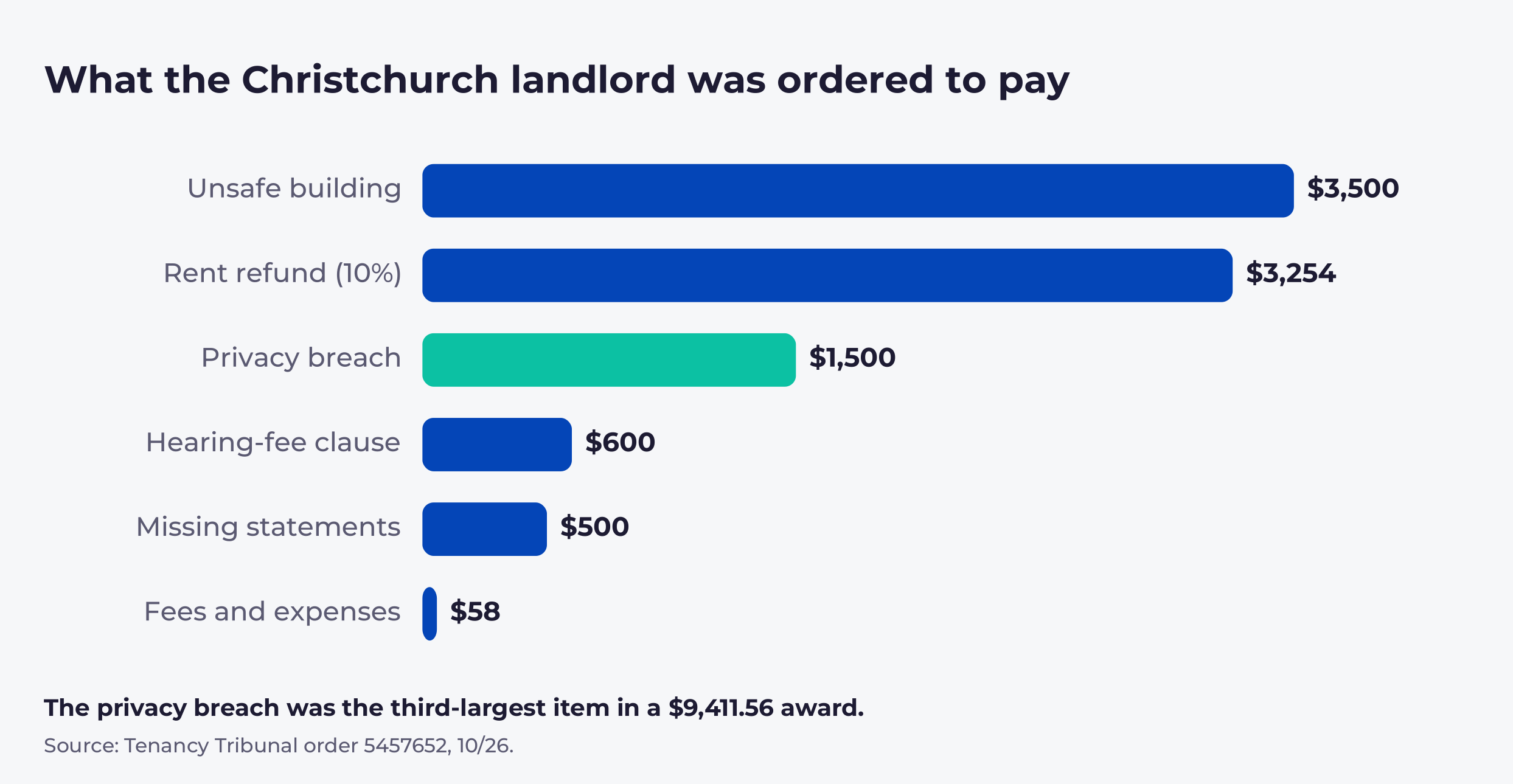
The cameras were one part of a wider case brought by MBIE, which also covered unconsented premises, missing statements and a $200-per-hearing fee clause. The landlord was ordered to pay $9,411.56, including $1,500 for the privacy breach, and restrained from repeating the breaches for four years.
What the Privacy Commissioner says landlords can do
The Office of the Privacy Commissioner’s rental guidance for landlords says it would be “unreasonably intrusive” to install cameras that could film or record tenants inside their home. It accepts that cameras in the public areas of an apartment complex could be justified, but only where the landlord has a lawful purpose for monitoring that area.
Its CCTV guidance adds that people must be told they are being recorded, usually by signs, and audio should be off unless necessary.
Cameras also bring an obligation many landlords overlook. Under principle 6 of the Privacy Act, people have a basic right to access information about themselves, and the Commissioner’s guidance on responding to access requests confirms this includes CCTV recordings. If a tenant asks for footage of themselves, the landlord or property manager needs to be able to respond.
In a Wellington boarding house case (4904260, 11/24), cameras covered shared areas with no signs and recorded audio the tenants didn’t know about. The adjudicator found this formed part of a pattern of harassment, noting that tenants should be able to relax “without the knowledge that their landlord is watching and listening”.
Privacy claims can also go beyond the Tenancy Tribunal. In a 2014 Human Rights Review Tribunal case, a homeowner whose CCTV covered a neighbour’s garden was ordered to pay $7,000, a figure the Tribunal said would usually have been $15,000 or more.
In another order (5067251, 03/25), there was evidence the owner had accessed footage from cameras at the rental. The adjudicator found this breached quiet enjoyment and ordered the cameras disconnected or removed, with certification that only the tenants could access them, or $5,000 paid instead.
What about tenants installing cameras?
The OPC’s guidance on CCTV at home says individuals usually aren’t covered by the Privacy Act unless their filming would be “highly offensive” to a reasonable person, such as filming into a neighbour’s bathroom. Nothing in the guidance speaks directly to a tenant filming a property manager during a viewing.
Fixing one to the property is different: minor change provisions in the RTA says tenants must ask in writing and landlords must respond within 21 days. Landlords can’t refuse a minor change but can set reasonable conditions such as where they may be fixed.
Chris Matthews of Tenancy says the question comes up regularly. “From time to time, we get calls from property managers about tenants putting up security cameras and neighbours getting concerned about their privacy,” he says. “Generally, tenants are allowed to have CCTV cameras for security purposes, as long as they’re being used reasonably and aren’t unnecessarily intruding on their neighbours’ privacy.”
What this means for property managers
Taken together, the guidance and the orders point the same way. Cameras inside a tenant’s home, or footage the owner dips into, are treated as an invasion of privacy, and telling the tenant about them doesn’t change that. Cameras covering a street, an entrance or a genuinely shared area are on safer ground, as long as there’s a clear purpose and people know they’re there. The middle ground, such as shared driveways or tenant-installed doorbells, is less settled.
So before a camera goes up on a managed property, check that it can’t capture inside a tenant’s home and that audio is off. Record why it’s there, put up signs naming who operates it, know who can retrieve footage if a tenant asks for it, and make sure the owner understands that accessing footage to keep an eye on tenants is a risk, whatever the agreement says. And when a tenant asks to install their own camera, treat it like any other minor change: reply in writing within 21 days and set reasonable conditions on placement and removal.